

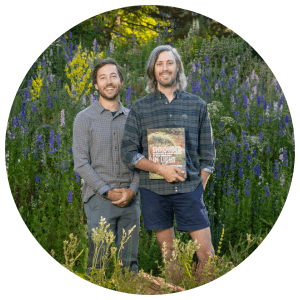
HPSO: Hello, Michael and Kevin, so good to have a chance to chat and learn a little more about both of you leading up to your presentation for us on 03/27/2025. Let’s start with the obvious: What type of garden do you have?
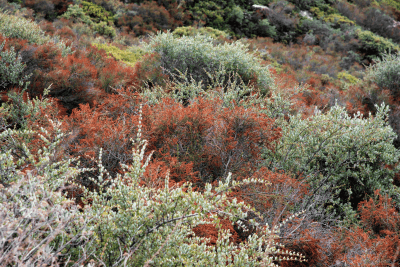
MICHAEL: My yard is a xeric shrubscape, dominated by shrubs and forbs from southwestern north America. The garden has been started primarily through customized seed mixes. I’ve tried to reuse and repurpose as much of the material in my yard as possible, including an old, failing concrete parking pad in my backyard, which has become a rubble garden, full of dwarf rabbitbrush, winterfat, and snakeweed. Tucked into the mix are veggie plots, full of heirloom tomatoes, peppers, and squash, growing happily alongside the naturalistic elements.
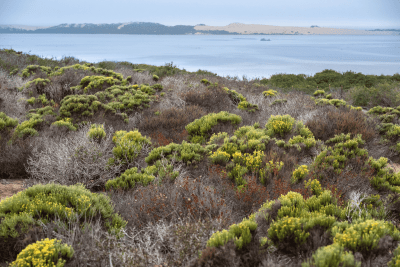
KEVIN: My front yard is a xeric shrubscape based on the sandsage of the eastern Colorado plains. It mixes regional and adapted species and hasn’t been watered since its installation in 2022. Since it was created through a mix of seeding and planting, it’s had the opportunity to change dramatically over the past few years. Even though it was very dry throughout the summer of 2024, the shrub-layer really started to come into its own, showing charisma and presence amongst the receding herbaceous plants and struggling grasses.
HPSO: Given that you just released “Shrouded in Light,” your choices for diverse and resilient ecosystems make a lot of sense. Can you tell us about a plant that you would like to be able to grow but can’t because of space, climate, etc.?
KEVIN: I wish I could fill my backyard with avocados, loquats and mangoes, but it’s too cold and dry in Denver.
MICHAEL: I dream of a vast mixed-crop orchard of apples, pears, stone fruit, and more. My memories of growing up in upstate New York are a major influence here.
HPSO: Ah, we can see how that stays on the vision board, given your homes in the Mile High State. So what’s your next garden project?
MICHAEL: This year, I’m excited to collaborate with researchers in Colorado to design and install several new green roof gardens that primarily use direct seeding methodology and take inspiration from shrubland and sub-shrub-dominated ecosystems from the American West. We will implement and monitor these projects with scientific precision to better understand the factors influencing plant establishment, persistence, and community health over time. Several of these projects will be publicly accessible and hopefully inspire folks to think beyond Sedum monocultures for green roofs.
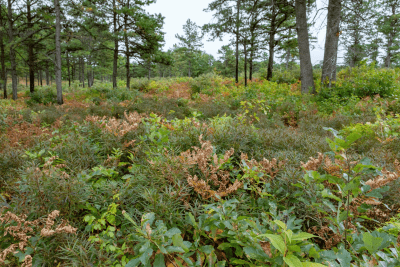
KEVIN: I’m excited to continue my work with the Denver Art Museum, creating an expansion to their Sensory Garden, which I helped design and continue to steward, working monthly with their Lifelong Learning and Engagement Team and a group of passionate volunteers. This expansion will encompass an event space with public art.
HPSO: What a great range of next projects! You caught our attention at “beyond Sedum,” Michael, what types of plants are you excited about?
MICHAEL: I’m fascinated by plants that have charismatic inter-species interactions. A focus of mine for a few years has been working with root parasites in the family Orobanchaceae, including Castilleja, Orthocarpus, and Pedicularis. I’m interested in finding ways to leverage their unique ecology to cultivate them in garden settings, including seeding them in situ with appropriate plant communities and pairing them directly with host plants during propagation.
HPSO: Kevin, what’s a future gardening trend you’d like to see?
KEVIN: I would like to see more of what I call ‘hard gardens’ — gardens that access and celebrate alternative aesthetics and emotions and unapologetically challenge their visitors to be excited, disgusted, saddened, and afraid.
HPSO: That’s really thought-provoking, thank you, Kevin. We get the impression you welcome challenging and unusual experiences, can you share a little more?
KEVIN: Well, during plant collecting expeditions, I find that I push myself further into the realm of discomfort or danger. Perhaps it’s just carelessness, or possibly because it’s part of my job, but there usually seems to be a moment of climbing too steep a hill, driving a bit too long, or eating something too sketchy that accompanies every trip.
One memory that I revisit frequently is the time two semi-trailers tried to pass each other on an unpaved stretch of the Pamir Highway in Tajikistan. Most of the Pamir Highway is restrained by a mountain on one side and a large drop into a raging river on the other. We were delayed quite awhile as they tried to untangle from one another. The moment a small gap opened on the road, our driver took off, trying to maneuver our SUV around the trucks. Unfortunately, this passage wasn’t even wide enough for our car, and as our wheels started to grind the edge of the cliff, everyone shouted for our driver to stop, I got ready to throw our data collection tablet out of the window, so that we’d leave some legacy behind and the trip wouldn’t be in vain. We almost got caught up in the tangle, but luckily, reason prevailed, and several people helped our driver back up to a safe stretch of road.
HPSO: Thanks for that hair-raising vignette and one that pays serious memory dividends still. Michael, can you share an area of the world where you’d most like to go botanizing?
MICHAEL: In general, islands! Places that have been geographically separated from a mainland continent for a long time are full of evolutionary oddities. They are fascinating because I can stroll through a habitat and have no idea what plants I’m observing, captivated by the wild and unexpected adaptations, forms, and interactions that have evolved in isolation to meet unique conditions. I don’t want to take away Australia’s continent status, but biologically it also functions as an island when it comes to the evolution of its plant and animal life. The vast, arid shrubland habitats of the Australian outback are definitely on my bucket list.
HPSO: Yes, those are tough environments that have to lead to some amazing adaptations among the plants and animals that inhabit them. We’d like to be on that botanizing team!
Thank you both for your time. We really appreciate it and look forward to your presentation on 03/27/2025 and spending some time poring over your newest collaboration: “Shrouded in Light.”
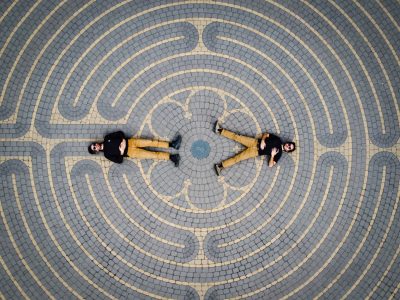
Kevin Philip Williams is a naturalistic gardener who collaborates with active and passive materials to create dynamic and challenging worlds. His unique style combines bioregional plant palettes, a hardcore punk ethos, and post-human aesthetics to craft wild and captivating spaces. Kevin's extensive work with Denver Botanic Gardens has led to the creation of celebrated public gardens throughout the city. Kevin was a Gardener on The High Line in Manhattan and studied as a Horticulture Intern at Brooklyn Botanic Garden. He holds a MS degree in Public Horticulture from the Longwood Graduate Program at the University of Delaware and a BA degree in The History and Philosophy of Science from Bard College.
Michael Guidi is an ecologist and horticulture researcher who is passionate about naturalistic plantings that embody the flexibility and resiliency of wild systems. His work draws inspiration from liminal urban spaces and wild areas alike. Preferring common and weedy plants to the rare and precious, Michael is a proponent of dynamic, self-sustaining gardens and green infrastructure as alternatives to static high-maintenance landscaping. His research links ecological theory with horticultural techniques and designs to broaden the definition of gardens and gardening. Michael worked as a field biologist before joining the Denver Botanic Gardens horticulture department. He holds a MS degree in Ecology from the Graduate Degree Program in Ecology at Colorado State University and a BS degree in Biology from Ithaca College.